Businesses have always relied on reports and historical data to understand performance. While useful, these methods only tell you what has already happened.
Modern organizations want something more powerfulâthey want to know what is happening right now and what is likely to happen next.
This is where Digital Twins are transforming industries.
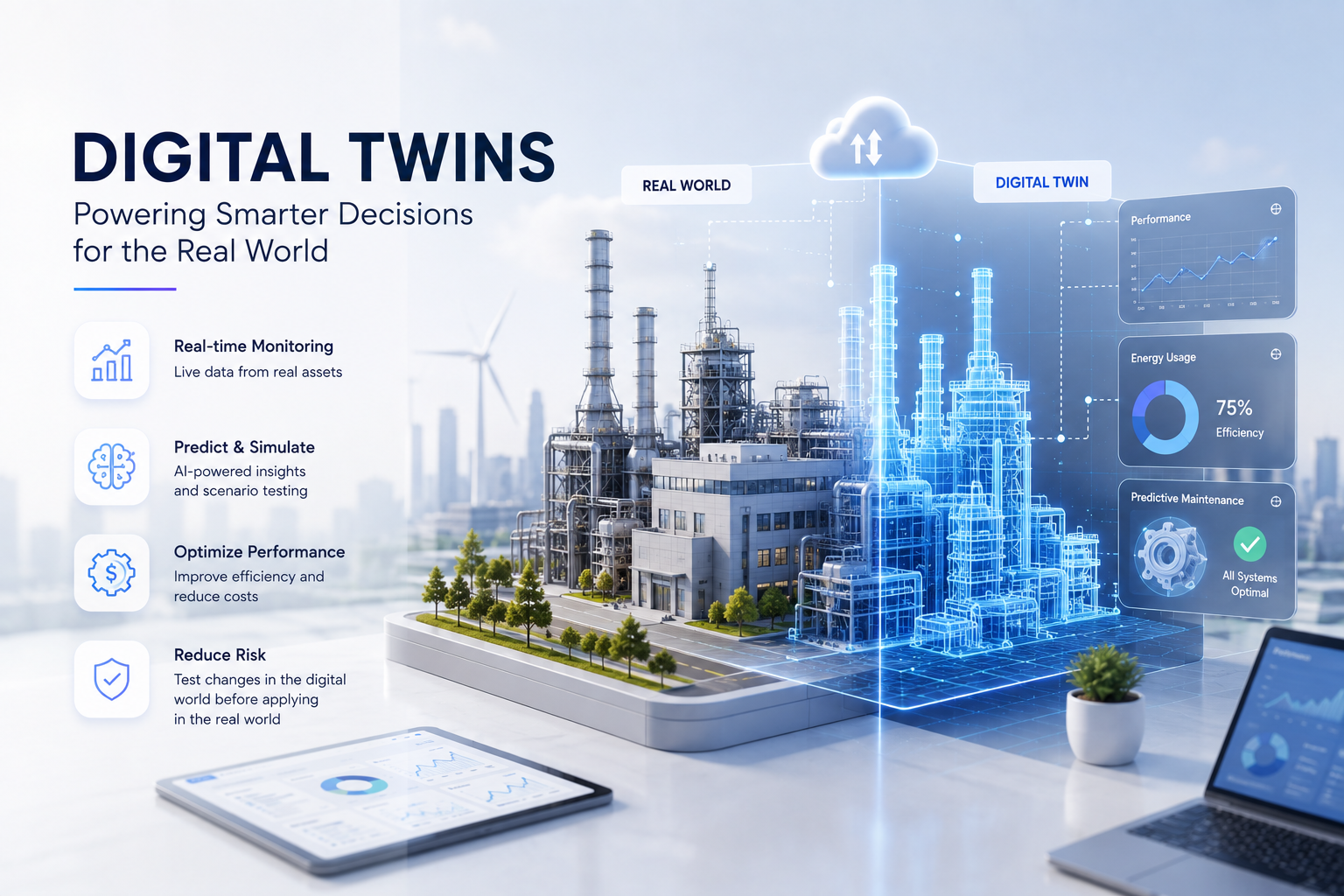
A Digital Twin is a virtual representation of a real-world object, system, or process that continuously receives live data. Instead of making decisions based on assumptions, companies can monitor operations in real time, simulate different scenarios, and predict future outcomes before implementing changes.
As AI, IoT, and cloud computing continue to evolve, Digital Twins are becoming one of the most valuable technologies for businesses that depend on efficiency and precision.
What Is a Digital Twin?
A Digital Twin is a dynamic digital model connected to a physical asset through real-time data.
Unlike a simple 3D model, a Digital Twin constantly updates itself using sensors, APIs, and connected devices.
For example:
- A warehouse can have a live digital replica showing inventory movement.
- A factory can monitor every machine in real time.
- A smart building can track energy consumption and occupancy.
- A logistics company can simulate delivery routes before dispatching vehicles.
The virtual model behaves like the real-world system, allowing businesses to test decisions without taking unnecessary risks.
Why Businesses Are Investing in Digital Twins
Digital Twins provide significant operational advantages.
Predictive Maintenance
Instead of waiting for equipment to fail, businesses can identify early warning signs and schedule maintenance before costly breakdowns occur.
Better Decision Making
Companies can test multiple scenarios inside the digital environment before making real-world changes.
This reduces risk while improving confidence.
Lower Operating Costs
By identifying inefficiencies in processes, businesses can optimize energy usage, reduce downtime, and improve overall productivity.
Real-Time Visibility
Managers gain instant insight into business operations from anywhere in the world.
Instead of waiting for reports, they can make informed decisions based on live data.
Industries Already Using Digital Twins
The technology is expanding rapidly across multiple sectors.
Popular use cases include:
- Manufacturing
- Smart Cities
- Healthcare
- Construction
- Logistics
- Aviation
- Renewable Energy
- Retail
- Real Estate
- Agriculture
As sensor technology becomes more affordable, Digital Twins are becoming accessible to businesses of all sizes.
How AI Makes Digital Twins Smarter
Artificial Intelligence enhances Digital Twins by turning raw data into actionable insights.
AI can:
- Detect unusual behavior
- Predict equipment failures
- Forecast demand
- Recommend operational improvements
- Optimize workflows
- Identify hidden patterns
Instead of simply displaying information, Digital Twins become intelligent decision-support systems.
What Developers Should Learn
Developers interested in this growing field should become familiar with:
- IoT device integration
- Cloud platforms
- Real-time data streaming
- AI and machine learning
- Dashboard development
- API architecture
- Data visualization
- Cybersecurity
- Edge Computing
These technologies work together to create scalable Digital Twin platforms.
Challenges to Consider
Despite their advantages, Digital Twins require careful planning.
Organizations should address:
- Data accuracy
- Sensor reliability
- System integration
- Network security
- Scalability
- Infrastructure costs
- Data privacy
- Long-term maintenance
A successful Digital Twin depends on high-quality, reliable data.
Final Thoughts
Digital Twins are redefining how businesses operate.
Instead of reacting to problems after they occur, organizations can monitor, simulate, predict, and optimize operations continuously.
As AI and connected devices become even more advanced, Digital Twins will play a central role in building smarter factories, cities, offices, and digital products.
Businesses that begin investing in this technology today will be better prepared for the intelligent, data-driven future.
Share this article
Copy the article link and send it to anyone who may find it useful.